
You've probably driven through the Red Canyon Arches on Scenic Byway 12 without knowing UDOT is watching every crack in them. These two sandstone arches have carried traffic since 1925. Now UDOT uses drones and laser scanners to keep them standing.
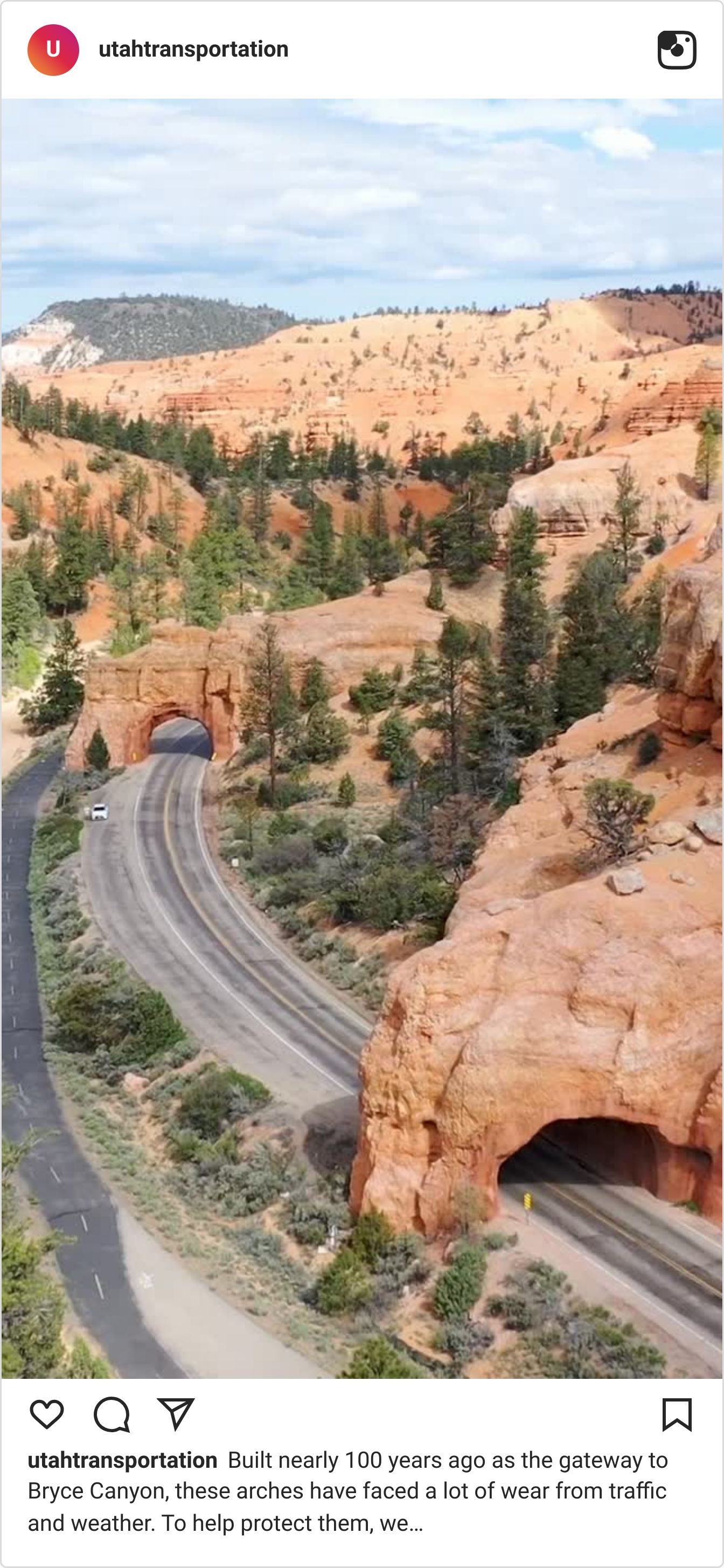
The arches, quick facts
What they are: Two natural sandstone arches on SR-12 in Red Canyon, between Panguitch and Bryce Canyon National Park.
Age: 100 years old. Recognized in 1925 as the original entrance to Utah National Park, now Bryce Canyon National Park.
Why they matter: They're a gateway to southern Utah's parks and a common stop for photos.
The problem: Erosion and traffic wear down the rock over time. Chunks can fall onto the road below.
What started this project
In 2019, a large vehicle collision scraped off part of the shotcrete (a sprayed concrete coating) that protects the inside of the arches. James Corney, UDOT Structures Project Engineer, described it to ABC 4: "We've recently gone through and repaired the arches from a hit that happened a couple of years ago. And it scraped some of the protective concrete coating that we have on the inside of the arches off."
Before 2019, UDOT checked the arches every two years. After the collision, they switched to constant monitoring.
The three tools UDOT uses
Tool | What it does |
|---|---|
Drones | Fly around the arches and take thousands of photos. Software turns these into a 3D model. |
Stationary LiDAR | Fires eye-safe laser beams through and under the arches to build a 3D point cloud of the rock. |
Sensors | Mounted directly on the arches to track displacement over time. |
Engineers combine data from all three to catch rockfall risk, deformation, or cracking before it becomes a road hazard.
What's happening next
UDOT secured funding this spring to start phase two. Crews will install new sensors at weak points in the arches, since some of the original sensors are damaged or no longer collecting good data. UDOT plans to install them this fall, once summer tourist traffic drops off.
If you're driving Highway 12 in the fall, expect to see crews working near the arches.
Why UDOT is doing this
UDOT Region Four Director Kirk Thornock explained the reasoning: "These archways are icons in our state, and we want to make sure we're doing what we can to preserve them for the future."
Corney put the cost logic behind it plainly: "We believe good roads cost less. That's why we're prioritizing extra monitoring of these arches, because preserving and maintaining our roads instead of responding reactively to larger problems costs the taxpayer less in the long run."
Corney also noted that UDOT places sensors in spots that stay out of view, so the monitoring doesn't disturb the area's natural look.
The bottom line
Next time you drive under the Red Canyon Arches, you're passing under a landmark that's being watched closely. Drones, lasers, and sensors are doing the work behind the scenes so this 100-year-old gateway to Bryce Canyon keeps standing.